
Mobile money charges in Uganda: government moves to amend the law
Mobile money charges in Uganda are under review: the Prime Minister met MTN and Airtel and ordered a draft law amendment. What it means for your organisation.
Mobile money charges in Uganda are under government review. On Friday, 20 November 2026, Prime Minister Robinah Nabbanja met managers from MTN Uganda and Airtel Uganda in Kampala and directed the Ministry of Finance, the Attorney General, the Uganda Revenue Authority and the Bank of Uganda to draft an amendment to the law that governs money lending in Uganda. No timeline was given, and no fees have changed yet.
What happened
According to Nile Post and Techpoint Africa, the meeting followed a debate in Parliament during Prime Minister's Question Time this week, where MPs said mobile money charges weigh most heavily on low-income earners. Nile Post reports that President Museveni had directed the Prime Minister to summon the operators.
Nabbanja told the operators the government wants a law that keeps mobile money affordable and accessible. Dawan Africa notes that she did not say when the draft would be ready or which charges it would cover, and that any amendment still has to go through the normal legislative process.
What MTN and Airtel said
Both companies said they do not set the full cost of the service on their own. MTN's Phrase Ruben described the business as linked to commercial banks, saying mobile companies are "just a conduit" (Nile Post). Airtel's Japhet Aritho said, "We do not set the full cost alone," and pointed out that mobile money helps Ugandans who cannot borrow from commercial banks.
Ruben told the meeting that more than Shs4.6 trillion circulates through mobile money, a figure reported by both Nile Post and Techpoint Africa.
Who regulates mobile money charges in Uganda?
Mobile money in Uganda is supervised by the Bank of Uganda under the National Payment Systems Act 2020, and the operators run the service through their licensed subsidiaries, MTN Mobile Money Uganda and Airtel Mobile Commerce Uganda, as Techpoint Africa explains. The new directive brings the Ministry of Finance, the Attorney General and URA into the drafting alongside the central bank.
What it means for Ugandan organisations
Nothing changes on your phone today. Current MTN MoMo and Airtel Money tariffs still apply until a new law or tariff is announced, so keep budgeting with today's rates. Here is what is worth doing now:
- Know what you pay. Add up a month of transaction and withdrawal charges on your business lines. Schools, SACCOs, shops and clinics are often surprised by the total.
- Separate charges in your records. Record the fee apart from the amount on every payment, so you can see the effect of any change straight away.
- Collect payments through a system, not a personal line. A merchant or API integration gives you receipts, references and statements per payment. Our mobile money API integration guide explains the options.
- Watch for the draft. When the amendment is published, read who it covers, as the operators say banks and other players share the cost.
At Victor Bee Technologies, a software company in Uganda, we build mobile money into school fees, transport cards and business apps. In School Pulse, every fee paid by mobile money produces a receipt the bursar can match, and the BeePass design tops up a transport card by MoMo.
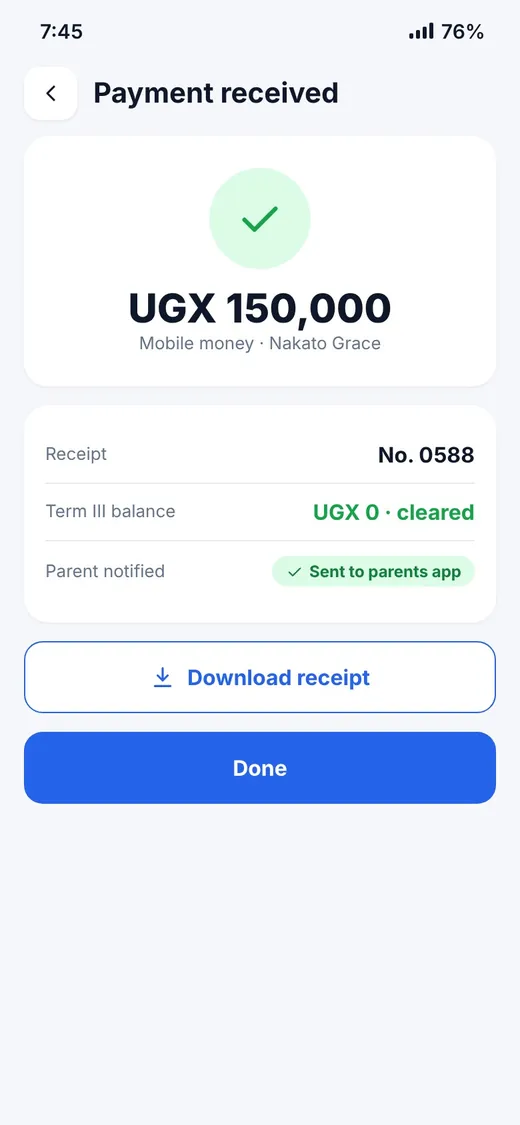
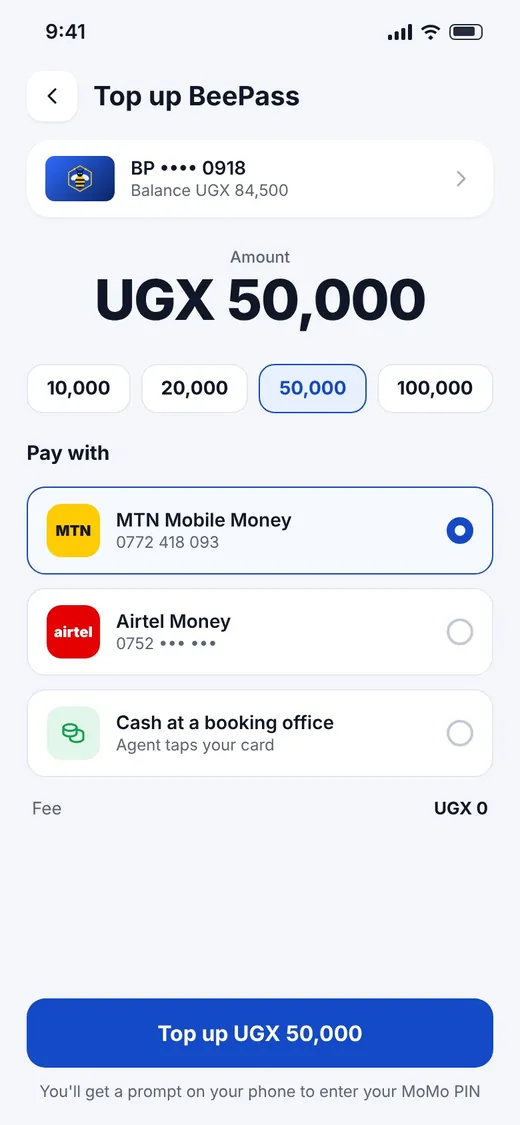
For more on mobile financial services, read MoKash at 10 and how banks are moving to NIRA biometric checks. Need payments built into your own system? See our services.
Frequently asked questions
Have mobile money charges in Uganda changed?
Not yet. The Prime Minister has ordered a draft amendment to the money lending law, but no new tariff or law has been announced, so the current MTN MoMo and Airtel Money charges still apply.
Who sets mobile money charges in Uganda?
The operators publish their own tariffs, and the Bank of Uganda supervises mobile money under the National Payment Systems Act 2020. MTN and Airtel told the Prime Minister that banks and other players also share in the cost of the service.
Which government bodies will draft the amendment?
The Ministry of Finance, the Attorney General, the Uganda Revenue Authority and the Bank of Uganda, according to Nile Post and Techpoint Africa. No deadline was announced.
How can a business reduce mobile money costs?
Start by measuring what you pay each month and recording charges separately. Collecting through a merchant or API integration also gives cleaner records and receipts, which makes it easier to compare costs between providers.
What to do next
Review a month of your mobile money statements this week, and if you want payments, receipts and reports in one system, talk to us on WhatsApp 0793 128 137 or email info@victorbee.com.
Sources
- MTN, Airtel Tell Nabbanja They Are Only Conduits as Government Moves to Amend Mobile Money Law, Nile Post
- Weeks after its London listing, Airtel Money faces a Ugandan push over mobile money charges, Techpoint Africa
- Uganda Mobile Money Charges: PM Orders Law Change, Dawan Africa
Keep reading

MoKash at 10: MTN MoMo and NCBA launch Shs140m rewards
MoKash turns 10: MTN MoMo and NCBA Bank Uganda report about UGX 3.2 trillion lent and launch a 12-week Shs140m rewards campaign. What it means for you.
Mobile money API integration in Uganda: a guide for organisations
Mobile money API integration in Uganda lets your system take MTN MoMo and Airtel Money payments automatically. How it works and how to plan it well.

Collecting school fees with mobile money: a practical guide for bursars
How Ugandan schools can accept MTN MoMo and Airtel Money fee payments and still keep clean, matched records for every learner.